AI is transforming call centers from cost centers into powerful growth engines. Instead of long wait times, frustrated agents, and siloed data, modern organizations are deploying AI call centers to deliver faster responses, higher satisfaction, and lower operating costs—benefits now driving adoption globally, including in markets embracing the centro de llamadas con IA model.
This guide explains what an AI call center is, how it works, and how you can leverage it to create standout customer experiences while unlocking the Long-term value of AI call center technology that fuels sustainable growth and stronger omnichannel performance.
An AI call center brings together automation, intelligence, and real-time insights to help businesses manage customer conversations with speed and consistency. By processing speech, intent, and context instantly, these systems rely on scalable computing technology to ensure smooth performance even during peak interaction volumes.
To support uninterrupted service, an AI call center requires robust processing environments capable of handling complex workloads at scale. This is enabled through high performance infrastructure, which helps maintain fast response times, accurate routing, and reliable automation across channels.
Beyond operations, an AI call center generates valuable insights that strengthen digital outreach. Conversation data reveals customer needs and preferences, supporting smarter engagement strategies aligned with online customer marketing focused on relevance and trust.
As businesses refine their customer journeys, AI-driven insights help optimize messaging and timing across platforms. This approach mirrors proven methods in digital marketing performance, where data-backed adjustments lead to higher engagement and conversion.
From a financial standpoint, an AI call center improves efficiency by reducing manual effort and increasing first-contact resolution. These gains contribute to sustainable growth through better cost control and stronger ROI, reinforcing the importance of business financial efficiency in long-term technology investments.
Together, these elements position the AI call center as a strategic system that connects technology, marketing intelligence, and financial performance into a single, scalable customer experience solution.
Top AI Call Center and Contact Center Solutions
Choosing the right AI call center platform can directly impact customer satisfaction, agent productivity, and operational efficiency. Below is a curated list of leading AI-powered contact center solutions, starting with Bright Pattern as the top choice, followed by nine well-known competitors in the AI call center space.
1. Bright Pattern
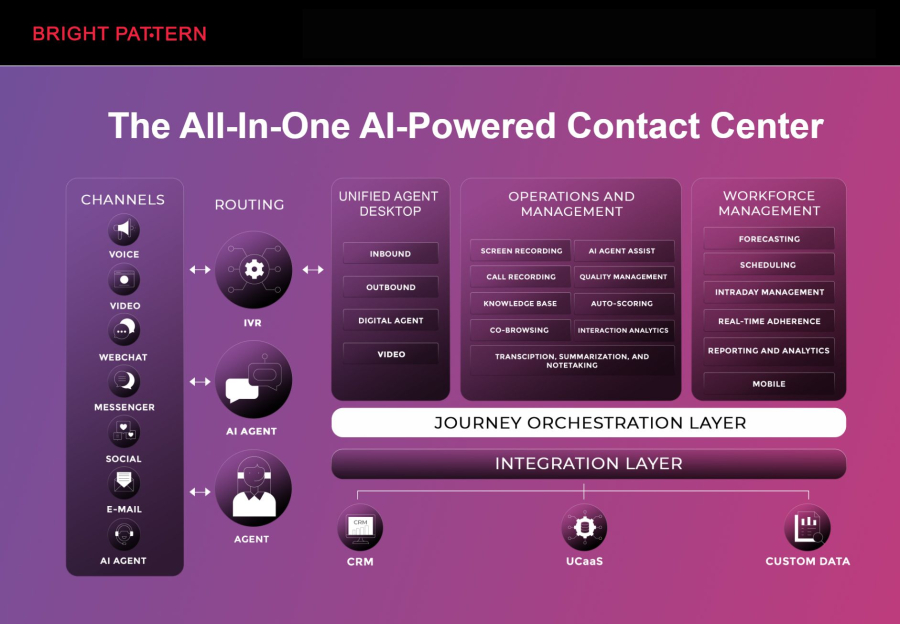
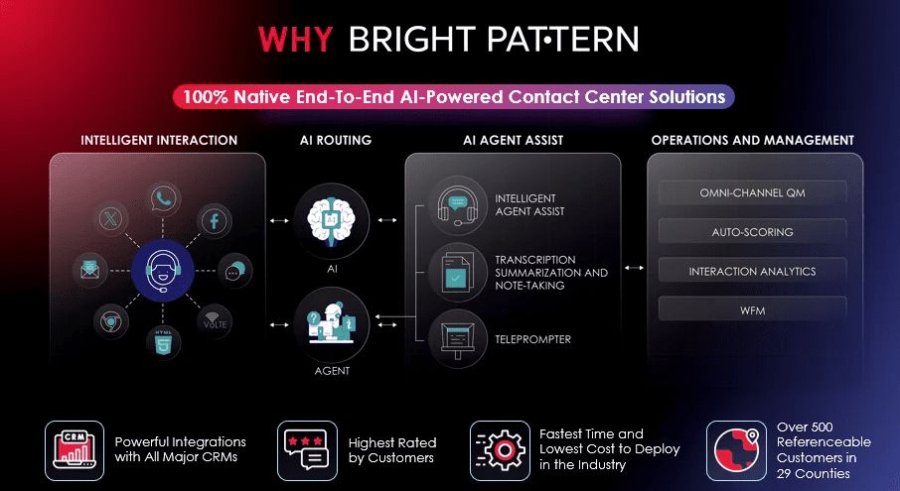
Bright Pattern stands out as a comprehensive AI call center and AI contact center solution designed to unify voice, digital channels, and automation into a single platform. It is built to support businesses that want intelligent routing, real-time insights, and seamless customer journeys without relying on disconnected tools.
Bright Pattern’s AI call center capabilities focus on improving both customer experience and agent performance while keeping operations flexible and scalable.
Key strengths include:
- AI-powered call routing that matches customers with the best agent in real time
- Integrated AI contact center tools for voice, chat, email, SMS, and social channels
- Real-time analytics and AI-driven insights to improve call center performance
- Automation features that reduce handle time and increase first-contact resolution
- Cloud-native architecture designed for fast deployment and global scalability
These features make Bright Pattern a strong choice for organizations looking to modernize their AI call center operations while maintaining full control over customer interactions.
2. Genesys
Genesys offers a cloud-based AI call center platform focused on journey orchestration and customer experience management. It is commonly used by large enterprises with complex omnichannel needs.
3. NICE CXone
NICE CXone provides an AI-driven contact center solution with advanced workforce optimization, analytics, and automation tools designed to improve efficiency in high-volume call centers.
4. Five9
Five9 is a cloud contact center platform known for AI-assisted dialing, virtual agents, and workforce engagement features aimed at improving outbound and inbound call center operations.
5. Talkdesk
Talkdesk delivers an AI call center solution with industry-specific workflows, automation, and reporting tools that support fast-growing customer service teams.
6. RingCentral Contact Center
RingCentral combines cloud communications with AI-powered contact center features, offering voice, messaging, and analytics within a unified ecosystem.
7. Amazon Connect
Amazon Connect is a scalable cloud-based AI call center platform that integrates with AWS services to enable automation, analytics, and machine learning-driven insights.
8. Cisco Contact Center
Cisco’s AI contact center solutions focus on enterprise-grade security, reliability, and integration with existing communication infrastructure.
9. 8x8 Contact Center
8x8 provides an AI-enabled contact center solution that combines voice, video, chat, and analytics to support global customer engagement.
10. Zendesk Contact Center
Zendesk offers AI-powered call center features tightly integrated with its customer support platform, making it suitable for teams focused on ticketing and customer history management.
This list highlights how AI call center platforms are evolving from basic support tools into intelligent systems that connect automation, analytics, and customer experience into a single contact center solution.
What Is an AI Call Center?
AnAI call centeris a customer service operation that uses artificial intelligence to automate and augment interactions across voice and digital channels. Rather than relying only on human agents, AI call centers combine technologies such as virtual agents, voice bots, natural language processing, and intelligent routing to handle a large portion of customer inquiries automatically.
AI call centers typically include:
- Virtual agents and chatbotsthat handle common questions over voice or chat without human intervention.
- Intelligent call routingthat matches customers with the best available agent or automated flow based on intent, history, and priority.
- Real time agent assistthat suggests responses, knowledge articles, or next best actions during live conversations.
- Speech analyticsthat transcribe and analyze calls to uncover trends, quality issues, and training opportunities.
- Automated quality monitoringthat evaluates interactions at scale instead of just a small sampling.
The result is a smarter, more efficient contact center that can serve more customers with less effort while maintaining a consistently high level of service.
How AI Call Centers Work
AI call centers sit on top of your existing telephony and contact center infrastructure or operate as cloud based platforms that integrate with your phone system, CRM, and ticketing tools. The AI layer listens, understands, and responds to customers in real time.
Core Components of an AI Call Center
- Automatic speech recognitionconverts spoken words into text so AI can process voice conversations.
- Natural language processinginterprets what customers are asking, even when they use their own words, slang, or incomplete sentences.
- Dialog managementcontrols the flow of the conversation, asking clarifying questions, confirming details, and moving customers toward resolution.
- Integration with back end systemsallows AI to access order information, account details, product data, or knowledge articles in real time.
- Text to speechconverts AI generated responses into natural sounding speech for voice calls.
Hybrid Human plus AI Model
The most effective AI call centers use ahybrid model. AI handles repetitive, high volume tasks, while human agents focus on complex, emotional, or high value interactions.
In practice, this looks like:
- AI greeting the customer, verifying identity, and capturing intent before routing to a human agent.
- Virtual agents resolving simple requests end to end, such as checking balances, updating contact details, or rescheduling appointments.
- AI monitoring live calls and chats, suggesting responses, compliance language, or cross sell opportunities to agents in real time.
- Seamless handoffs from AI to humans, with full context and conversation history preserved.
This partnership between humans and machines creates faster, more accurate service without sacrificing empathy or personal connection.
Key Benefits of AI Call Centers
Organizations adopt AI call centers for many reasons, but the benefits usually cluster around three pillars: experience, efficiency, and insight.
1. Better Customer Experience
- 24 or 7 availabilityso customers can get help anytime, not just during business hours.
- Shorter wait timesbecause AI handles a large portion of requests instantly.
- Consistent answersbased on centralized knowledge, instead of relying on individual agent memory or interpretation.
- Personalizationusing customer history, preferences, and behavior to tailor responses and recommendations.
2. Greater Operational Efficiency
- Lower cost per contactby automating repetitive tasks and simple interactions.
- Improved first contact resolutionas AI surfaces the right data and next steps instantly.
- Reduced agent handle timethrough suggested replies, automation of after call work, and pre filled forms.
- Scalabilityto handle seasonal spikes or sudden surges in volume without scrambling to hire and train new staff.
3. Deeper Insights and Continuous Improvement
- Full interaction analyticsfor nearly 100 percent of calls and messages, not just a small sample.
- Automatic topic discoveryto reveal emerging issues, product feedback, or friction points in your journey.
- Performance dashboardsthat highlight coaching opportunities for agents and optimization opportunities for workflows.
- Data driven decision makingfor staffing, training, and process redesign based on real conversations.
Top Use Cases for AI Call Centers
AI can add value across industries and customer service scenarios. Below are some high impact use cases where organizations commonly see early wins.
Self Service and Virtual Agents
Virtual agents can handle a wide range of routine requests such as:
- Order status and delivery tracking.
- Account balance inquiries and payment confirmations.
- Password resets and basic account security checks.
- Appointment booking, changes, and cancellations.
- Store hours, location information, and simple FAQs.
By shifting these tasks from human agents to AI, organizations significantly reduce queue lengths and free agents to tackle more complex customer needs.
Intelligent Routing and Triage
AI can listen to what customers say or read what they type and automatically determine:
- What the customer is trying to achieve.
- How urgent or high risk the situation is.
- Which skill set or department is best suited to help.
- Which agent currently has capacity and the right expertise.
Thisintent based routingimproves resolution times and reduces frustrating transfers, where customers need to repeat their story over and over.
Agent Assist and Knowledge Suggestions
During a live interaction, AI can:
- Transcribe the conversation in real time.
- Highlight key details like names, dates, and order numbers.
- Surface relevant knowledge base articles, policies, or troubleshooting steps.
- Suggest compliant language for regulated industries, such as finance or healthcare.
This support helps new agents ramp faster and experienced agents work more confidently and efficiently. It also reduces errors and ensures greater consistency.
Post Call Analytics and Quality Management
Instead of manually listening to a tiny fraction of calls, AI can automatically review nearly every interaction to assess:
- Customer sentiment and emotional tone over the course of the call.
- Agent adherence to scripts, disclosures, or compliance requirements.
- Reasons for calls, escalation drivers, and repeat contact triggers.
- Upsell and cross sell opportunities mentioned but not captured.
Leaders can then use this insight to refine training, update scripts, adjust processes, and improve product design.
AI Call Centers vs Traditional Call Centers
The shift from a traditional call center model to an AI powered one is not just about technology. It changes how you operate, staff, and measure success.
Aspect | Traditional Call Center | AI Call Center |
Availability | Limited to staffed hours | 24 or 7 coverage via virtual agents |
Scalability | Requires hiring and training more agents | AI absorbs volume spikes; humans handle exceptions |
Cost Structure | Primarily labor based | Blends automation with targeted human work |
Quality Monitoring | Sample based review of interactions | Automated analysis of most or all interactions |
Customer Experience | Dependent on agent availability and skill | Faster, more consistent responses with personalization |
Data and Insights | Limited, often manual reporting | Rich analytics and trend detection in near real time |
Implementation Roadmap: How to Get Started
Moving to an AI call center is a journey, not a single project. A phased approach allows you to capture quick wins while building toward a comprehensive transformation.
Step 1: Define Objectives and Success Metrics
Start by clarifying what you want AI to achieve. Common objectives include:
- Reducing average handle time.
- Improving first contact resolution.
- Lowering cost per contact.
- Increasing customer satisfaction or net promoter scores.
- Extending service hours without adding headcount.
Set clear, measurable targets so you can track impact over time.
Step 2: Map Customer Journeys and Identify Use Cases
Analyze your current interactions to find ideal starting points for AI:
- High volume, repetitive inquiries that follow predictable patterns.
- Tasks that require access to structured data but little judgment.
- Processes that cause long waits or frequent transfers.
These areas usually deliver the fastest return on investment when automated.
Step 3: Prepare Your Data and Knowledge
AI performs best when it has access to accurate, well organized information. Before deploying, focus on:
- Cleaning and standardizing customer and account data.
- Structuring your knowledge base with clear articles and decision trees.
- Ensuring security and privacy controls for sensitive information.
A strong data foundation sets your AI call center up for reliable, trustworthy performance.
Step 4: Start Small, Then Scale
Launch with one or two carefully chosen use cases, such as order tracking or password resets. Monitor performance, gather customer feedback, and refine conversation flows. Once you are confident in results, expand AI coverage to more tasks and channels.
Step 5: Train and Support Your Agents
Agents are central to the success of an AI call center. Ensure they understand that AI is there to support them, not replace them. Provide training on:
- How to collaborate with virtual agents.
- Using real time suggestions and knowledge prompts.
- Handling escalations that originate from automated interactions.
When agents feel empowered, they become advocates for the new approach and help unlock greater value from the technology.
Best Practices to Maximize ROI from AI Call Centers
To make the most of your investment in AI, focus on these proven practices.
Keep Humans in the Loop
Even the most advanced AI cannot handle every situation. Design your workflows so customers can reach a human easily, especially for sensitive, emotional, or high value issues. Clear handoff paths preserve trust while still delivering efficiency.
Design Conversations, Not Just Scripts
Effective virtual agents depend on well designed dialog flows. Craft conversations that:
- Use natural, friendly language.
- Ask clear questions with guided choices when needed.
- Confirm critical details to avoid errors.
- Offer graceful exits to a human agent.
Continuously Train and Improve
AI models learn from data. Build feedback loops that use real interactions to refine understanding, expand coverage, and correct mistakes. Regular updates keep your AI call center aligned with changing products, policies, and customer expectations.
Measure What Matters
Beyond traditional metrics like handle time and abandonment rates, track KPIs such as:
- Containment rate for virtual agents, meaning how many interactions AI resolves without human help.
- Customer satisfaction by channel and by type of interaction.
- Agent satisfaction and productivity gains from AI assistance.
- Cost savings relative to baseline operations before AI deployment.
Future Trends in AI Powered Contact Centers
AI call centers are evolving rapidly. Several trends are shaping the next wave of innovation.
More Natural Conversations
Advances in language models are enabling virtual agents that understand context, handle longer conversations, and respond in a more human like way across voice and text, making automated interactions feel smoother and more intuitive.
Proactive Support
Instead of waiting for customers to ask for help, AI can predict when they may run into issues based on behavior, usage patterns, or historical data. The contact center can then reach out proactively, turning potential problems into positive experiences.
Deeper Personalization
By combining contact center data with information from other systems, AI will deliver highly tailored experiences, from product recommendations to customized troubleshooting paths.
Unified Omnichannel Journeys
AI will increasingly provide a single brain across phone, chat, messaging, email, and social channels. Customers will be able to start on one channel and continue on another without losing context or repeating information.
Final Thoughts: Turning Your Call Center into a Strategic Advantage
AI call centers are more than a technology upgrade. They are a strategic shift in how you engage, support, and learn from your customers.
By combining intelligent automation with empowered human agents, you can deliver faster service, richer experiences, and deeper insights at scale. Organizations that embrace this transformation today are well positioned to turn their contact centers into competitive advantages rather than cost centers.
The path to an AI call center is incremental and manageable. Start with clear goals, choose high impact use cases, and build a culture where humans and AI work together. The payoff is a more resilient, responsive, and customer centric operation ready for the future of service.
